Dressed in Motion: How to Engineer Visual Energy Into Any Outfit

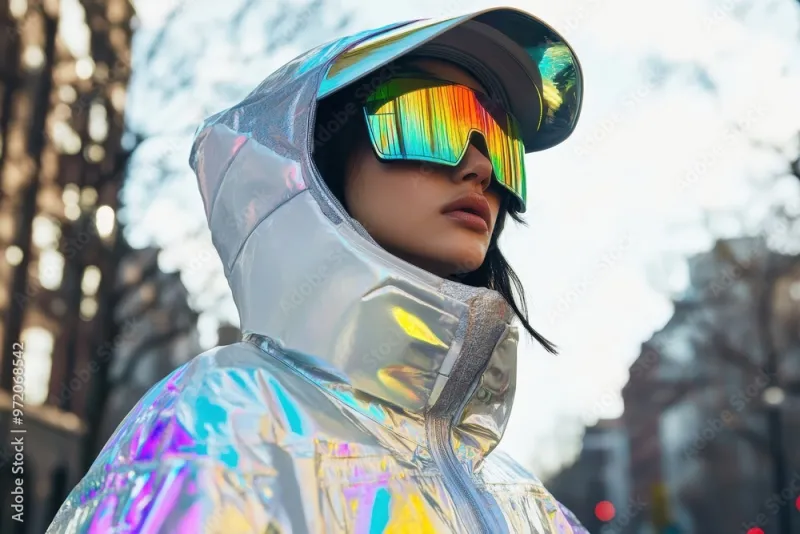
Photo by Photo by Raden Prasetya on Unsplash on Unsplash
There's a physics concept called the Doppler effect — the way a sound shifts pitch as its source moves toward or away from you. It's the reason an ambulance siren sounds different when it's approaching versus when it's already passed. You're not imagining the change. The wave is doing something real.
Now think about the last time an outfit stopped you cold. Not because it was loud or expensive, but because something about it seemed to move — even when the person wearing it was standing completely still. That's not magic. That's design doing exactly what physics does. And once you understand the mechanics, you can replicate it yourself.
Why Static Dressing Feels Flat
Most of us build our closets around individual pieces — a great blazer here, a reliable pair of jeans there. What we rarely think about is how those pieces interact as a system. When every element of an outfit sits at the same visual weight, the same texture level, the same color temperature, the result reads as flat. Two-dimensional. Like a photograph of clothes rather than clothes on a living person.
The human eye is wired to follow contrast and change. When there's nothing to follow, the eye stops. And when the eye stops, the outfit stops with it.
The good news: you don't need to overhaul your wardrobe. You need to start thinking about what your clothes are doing to light, to silhouette, and to the space around your body.
Color as a Frequency
Here's where the Doppler analogy gets useful. Just like sound frequencies shift with movement, color has its own kind of frequency — warm tones advance toward the viewer, cool tones recede. When you place them in strategic relationship to each other on your body, you create the optical illusion of depth.
Try this: pair a warm, saturated tone at your core (chest, waist) with cooler, muted shades at the edges (sleeves, collar, hem). Your eye will naturally read the warm center as closer, the cool edges as further away. The result is an outfit that appears to have dimension — like it's curving around a shape rather than lying flat against it.
This isn't new. It's what painters have done for centuries. Fashion designers like Issey Miyake and more recently labels pushing into technical apparel have been applying these principles to garments for decades. You can do it with pieces you already own.
Texture: The Dimension You Can Feel From Across the Room
Texture is the most underused tool in the average American closet. We tend to think of it as a tactile thing — something you notice when you touch a fabric. But texture is also intensely visual. A matte surface absorbs light and flattens form. A shiny or ribbed surface catches and scatters light, creating micro-shadows that make the eye move.
The trick is contrast. Pairing a chunky knit with a smooth satin slip skirt, or a brushed flannel shirt over a crisp poplin tee — these combinations create visual friction in the best possible way. Your eye doesn't know where to land, so it keeps traveling. That movement is what makes an outfit feel dynamic.
Think in terms of at least two distinct texture registers per outfit: one that absorbs light and one that reflects or diffuses it. It's a simple rule that pays off every time.
Silhouette and the Art of Controlled Volume
Fit is where most people play it safe, and it's the one area where a little risk creates the most reward. Silhouette is essentially the outline your body draws in space — and when that outline is too predictable, too uniform, it reads as static.
The designers who are really pushing 4D thinking in fashion right now — and you can see this in collections from Comme des Garçons to homegrown American brands experimenting with technical cuts — are obsessed with what happens at the transition points of the body. The shoulder-to-sleeve break. The waist-to-hip relationship. The way a hem hits in motion versus at rest.
You don't need avant-garde pieces to work with this. Try introducing one element of unexpected volume — a wide-leg trouser with a fitted top, an oversized shirt tucked asymmetrically, a structured outer layer left open over something fluid. The contrast between fitted and relaxed creates a visual rhythm. Your silhouette becomes a shape that changes as you move through a room, not just a static outline.
Layering as a Time-Based Medium
Here's a reframe that might change how you think about getting dressed: layering isn't just about warmth or practicality. It's about creating reveals — moments where one element of an outfit becomes visible only under certain conditions. A lining that flashes when you walk. A shirt that peeks from under a sweater and shifts as you move. An undershirt that changes the color read of a sheer outer layer.
This is time-based design. The outfit tells a different story at 9am when you're in a meeting, at 1pm when you're walking to lunch, and at 7pm when you've shed a layer. That evolution is what makes clothes feel alive rather than decorative.
Start small: add one piece to your usual rotation that's specifically chosen for what it does underneath something else. A long-hem layer that peeks below a shorter jacket. A contrast-color turtleneck under a crew-neck sweater. The reveal doesn't need to be dramatic to be effective.
Putting It Together Without Starting Over
None of this requires a shopping spree. It requires a shift in how you look at what you already have.
Pull out three outfits you wear regularly and run them through this checklist:
- Are there at least two different color temperatures in play?
- Is there texture contrast — at least one matte and one light-catching surface?
- Does the silhouette have at least one point of unexpected volume or asymmetry?
- Is there a layered element that reveals or changes as you move?
If you're hitting zero or one on that list, your outfit is working in two dimensions. Add one element that addresses any of the missing points, and see what happens.
The goal isn't to dress louder. It's to dress deeper — to build outfits that reward a second look, that seem to shift when the light changes, that feel like they have an interior life. That's what multidimensional dressing actually means. Not more dimensions in your wardrobe — more dimension in how you think about it.