Same Outfit, Totally Different Vibe: Why Context Is the Hidden Force Shaping What You Wear
You've experienced this before. You leave the house feeling locked in — the fit is right, the colors work, everything clicks. Then you walk into a different space, a different light, a different energy, and something shifts. The outfit hasn't changed. But somehow, it reads completely differently.
This isn't a malfunction. It's actually one of the most fascinating dynamics in fashion, and it's almost never talked about. Your clothes don't exist in a vacuum. They exist in motion, inside environments that are constantly reshaping how they're perceived. Think of it like a frequency wave — the same signal hitting different surfaces produces entirely different sounds. Your wardrobe works the same way.
The Physics Behind the Perception
Light is where this starts. A neutral cream linen shirt under cool fluorescent office lighting looks crisp, maybe a little stark. That same shirt under the warm amber glow of a cocktail bar becomes something softer, almost luminous. Step outside into golden hour sunlight and it transforms again — suddenly it's the most effortless thing anyone's ever worn.
This isn't just a vibe shift. It's physics. Different light wavelengths interact with fabric dyes and textures in genuinely different ways. Matte fabrics absorb light and read flat indoors, then come alive in natural sunlight. Metallic weaves that feel like overkill under fluorescents suddenly make perfect sense under stage lighting. Deeply saturated colors can look almost aggressive in a quiet meeting room but perfectly calibrated at an outdoor festival.
When designers talk about how a garment "moves," they're partly talking about this — how it performs across the range of lighting conditions a person might encounter in a single day. The best pieces are engineered, consciously or not, to shift well.
Speed and Motion Change Everything
There's another layer here that's even less discussed: how movement itself changes what your clothes communicate.
When you're standing still — waiting for your coffee, sitting in a meeting — an outfit is basically a static image. People read it the way they'd read a photograph. Details matter. Fabric quality is visible. The precision of a collar or the exact cut of a trouser leg comes through clearly.
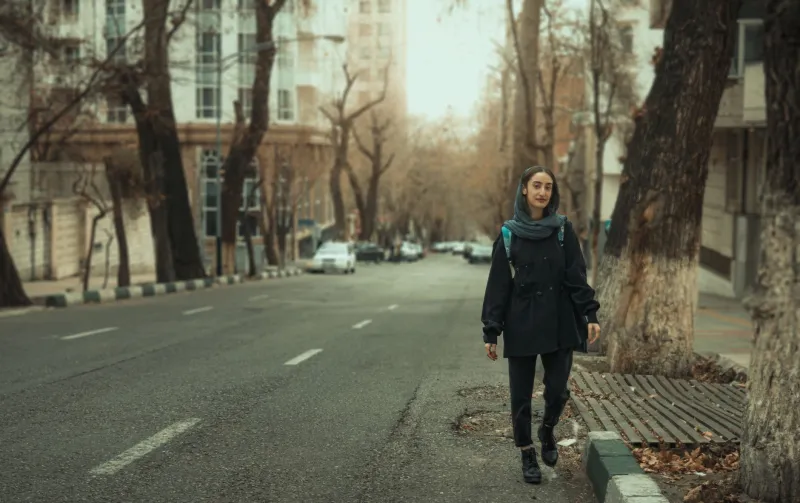
But when you're moving through space — walking fast through a crowded street, dancing, cutting through a busy airport — the outfit becomes something else entirely. It becomes gestural. Silhouette dominates. Color and contrast do the heavy lifting. The micro-details that read so clearly up close blur into an overall impression.
This is why certain outfits that look almost too simple in a dressing room mirror absolutely own a room once you're actually living in them. The movement activates the design. And it's why some technically precise, detail-heavy looks fall flat in dynamic environments — they were built for the still frame, not the moving picture.
Environment as the Fourth Wall
Beyond light and motion, there's the broader environmental context — the architecture, the crowd, the cultural temperature of a space.
A sharp, structured blazer in a downtown Manhattan office reads as confident and in-control. That same blazer at a backyard barbecue in Austin reads as overdressed and weirdly tense. The garment hasn't changed. The environment has completely reframed its meaning.
This is the part that trips people up most often. We tend to evaluate outfits in isolation — on a hanger, in a mirror, in the context of one specific occasion. But clothes are experienced relationally. They exist in conversation with everything around them: the people in the room, the architecture, the occasion's emotional register, even the season.
High-contrast outfits — bold black and white combinations, graphic color blocking — tend to hold their own across a wider range of environments because they generate their own visual gravity. They don't rely as heavily on their surroundings to "activate." Softer, more tonal looks are more context-dependent. They can be transcendent in the right setting and almost invisible in the wrong one.
Designing for Dimensional Range
So what do you actually do with this information? You start thinking about your outfits the way a cinematographer thinks about a shot — not just what it looks like in one moment, but how it's going to read across different conditions.
Before you commit to a look, run it through a few quick mental scenarios:
Where will I be when the light changes? If you're going from an office to a dinner to a bar in a single day, think about how your outfit performs across those lighting conditions. Warm neutrals and rich textures tend to translate well. Bright neons can be exhausting across a long day of shifting environments.
How much will I be moving? A day of back-to-back meetings calls for something that reads well stationary. A day that involves walking, commuting, and being on your feet rewards a silhouette that moves with intention — something with visual coherence at a distance, not just up close.
What's the cultural temperature of each space? This isn't about dressing "appropriately" in some stuffy, rule-following sense. It's about understanding that environments have their own aesthetic frequencies, and the most interesting dressing happens when you're in conversation with that frequency — not ignoring it entirely, not surrendering to it completely.
The Outfit That Lives in Four Dimensions
The most compelling thing about this whole phenomenon is what it says about what fashion actually is. It's not a static object. It's not even really a choice you make once in the morning. It's an ongoing, dynamic relationship between what you're wearing, where you are, how you're moving, and who's experiencing it alongside you.
That's the essence of what 4D dressing actually means — not just clothes that look good in one context, but clothes that are alive across multiple dimensions of your day. Pieces that shift and adapt and read differently depending on the frequency they're encountering.
The goal isn't to find one perfect outfit. It's to understand how your clothes behave in the wild — and to use that knowledge to build a wardrobe that works not just in theory, but in motion, in light, in context, in life.
Your clothes are always in conversation with the world around them. The question is whether you're paying attention to what they're saying.