Your Outfit Just Read the Room: Inside the Rise of Environmentally Aware Clothing
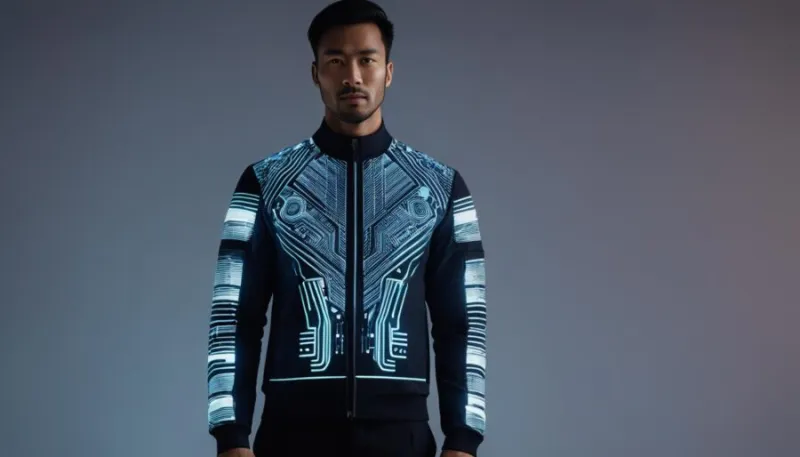
Photo: futuristic smart fabric jacket technology close up, via www.pouted.com
Picture this: you step out of a rideshare into a muggy August afternoon in Austin, and the jacket you're wearing opens microscopic vents across your back before you've even noticed the heat. Later that night, walking into a dimly lit cocktail bar in East Austin, the same jacket deepens from slate gray to near-black. Nothing was zipped, buttoned, or swapped. The garment simply knew.
If that sounds like a gimmick from a concept store in Tokyo, hang on. According to the researchers we spoke with, clothing that responds to its surroundings is further along than most shoppers realize — and it's coming to American retail faster than the industry's own marketing departments can keep up with.
The Garment as a Sensor
At the heart of adaptive clothing is a simple reframing: a garment isn't a static object but a system with inputs and outputs. Temperature, humidity, UV exposure, even ambient light levels become data. Phase-change materials, thermochromic dyes, and shape-memory polymers become the mechanisms that respond.
"We've spent a century engineering clothes to resist the environment," one wearable-tech researcher told us. "The next century is about engineering clothes to negotiate with it."
Some of this is already on racks, even if nobody's calling it adaptive. Moisture-wicking performance fabrics, UV-reactive swimwear, and puffers with vents that respond to body heat all live on the same design continuum. What's changing is the sophistication — and the intent. The new generation of garments doesn't just cope with the environment; it performs differently because of it.
Color That Thinks
Thermochromic and photochromic pigments — the same chemistry behind mood rings and transition lenses — are the most visible frontier. Early versions washed out fast and offered a palette of maybe three unconvincing shades. Current iterations are dramatically better: sharper transitions, more durable coatings, and colors that shift across genuinely wearable ranges.
The near-term applications are more practical than flashy. A commuter jacket that brightens in low light solves a real safety problem. A dress that shifts tone between a sunlit patio and a candlelit dining room isn't just a party trick — it's one garment doing the job of two, which matters to anyone trying to pack light or buy less.
Silhouette on Demand
The deeper innovation is structural. Shape-memory alloys and engineered textiles that stiffen or relax in response to heat and movement are making convertible silhouettes genuinely elegant rather than Frankenstein-y. Think blazers with lapels that relax for daytime and sharpen for evening, or skirts with hemlines that adjust via a nearly invisible actuator thread.
The design philosophy here is pure fourth-dimension thinking: the garment is not a fixed form but a form that unfolds over time and context. In our view, that's the most honest definition of multidimensional style — clothing evaluated not by how it hangs on a hanger, but by how it behaves across the hours you actually live in it.
So When Can You Buy This?
Here's the honest answer: piecemeal, and soon; wholesale, not yet.
Performance-adjacent adaptive features — thermal regulation, UV response, water-reactive finishes — are already mainstream in US outdoor and athleisure categories. Walk into any REI or scroll a Lululemon drop and you're buying adaptive tech without the branding.
The flashier stuff — color-shifting statement pieces, shape-morphing silhouettes — remains boutique. Price is the obvious barrier, but durability is the real one. Consumers have been burned by gadget-clothing before, and researchers know it. "Nobody wants a jacket that needs a firmware update," one designer quipped. The winning products will be the ones where the tech disappears entirely into the wearing experience.
Our prediction: within three to five years, environmental responsiveness stops being a feature and starts being an expectation — the way moisture-wicking went from novelty to default. The brands that get there first won't market the technology. They'll market the feeling of a wardrobe that's finally paying attention.
The fourth wall between your clothes and the world is coming down. What you wear is about to be a conversation, not a statement.